Understanding Posterior Tibial Tendonitis: Symptoms, Diagnosis, and Treatment from a Foot Specialist
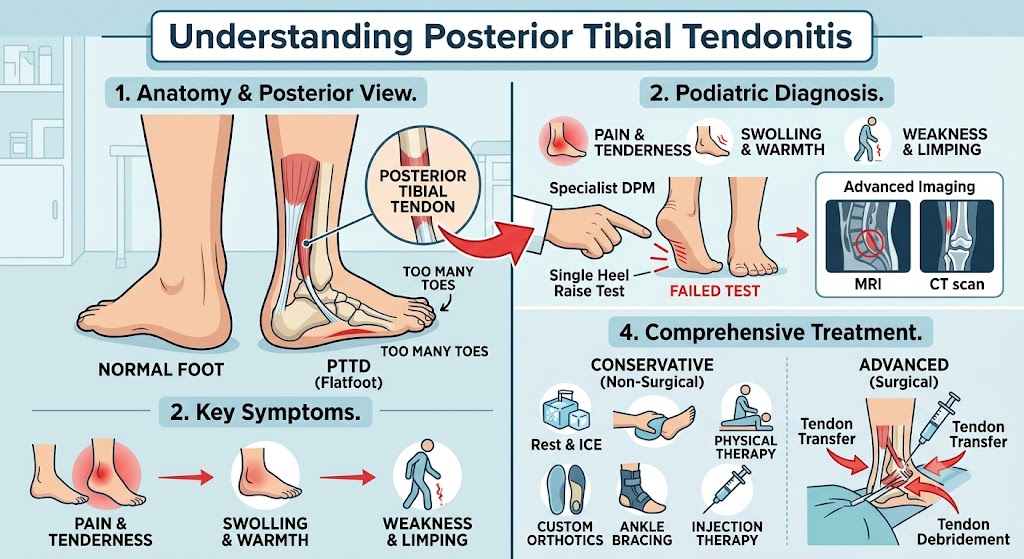
When patients visit our ACE Foot and Ankle Medical Clinic complaining of persistent pain along the inside of their ankle, one of the most frequent culprits we identify is Posterior Tibial Tendonitis. Often progressing to Posterior Tibial Tendon Dysfunction (PTTD), this condition can significantly impact your daily mobility if left unaddressed.
The posterior tibial tendon is one of the most critical structural components of your lower extremity. It attaches your calf muscle to the bones on the inside of your foot, serving as the primary anchor that holds up your foot’s natural arch. When this tendon becomes inflamed, overstretched, or torn due to overuse or poor biomechanics, it can compromise your entire gait. As foot and ankle specialists, we believe understanding this condition is the first step toward recovery.
1. Symptoms: Signs of Posterior Tibial Tendonitis
In the early stages, posterior tibial tendonitis can mimic general foot fatigue, but it quickly evolves into a localized issue. The most common symptoms we observe in our clinics include:
- Pain and Tenderness: Sharp or aching pain located along the inside of the foot and ankle, right behind the medial malleolus (the bumpy inner ankle bone). This pain typically intensifies with high-impact activities, running, or prolonged standing.
- Swelling: Visible puffiness, warmth, or redness along the track of the tendon on the inner ankle.
- Flattening of the Arch: As the tendon weakens and fails to support the foot, the medial arch gradually collapses. If you look at your feet from behind, you might notice your heel turning outward—a clinical sign known as the “too many toes” sign.
- Inability to Perform a Single-Leg Heel Raise: A classic milestone of advanced tendonitis or structural weakness is the inability to stand on the affected foot and raise your heel off the ground without severe discomfort.
2. Diagnosis: How a Podiatrist Evaluates the Condition
Diagnosing posterior tibial tendonitis requires a thorough clinical assessment by a foot specialist. Relying on basic internet searches can lead to mismanaging what could become a progressive deformity. When you visit a podiatrist, the diagnostic protocol generally involves:
- Physical and Biomechanical Examination: We evaluate your foot structure while non-weight-bearing, standing, and walking. We check for localized tenderness along the posterior tibial tendon and test your muscle strength.
- The Single-Heel Raise Test: We will ask you to lift your heel while standing on one foot. This allows us to assess whether the tendon is merely inflamed or functionally compromised.
- Advanced Imaging Protocols:
- In-Office Digital X-Rays: While X-rays do not show soft tissue like tendons, they are essential to check for joint alignment, rule out fractures, and assess the degree of arthritic changes or flatfoot severity.
- Diagnostic Ultrasound or MRI: If we suspect a partial tear, severe degeneration, or if conservative treatments are stalling, an advanced imaging scan provides a clear picture of the internal soft tissue damage.
3. Treatment: Restoring Structure and Relieving Pain
At ACE Foot and Ankle Medical Clinic, our treatment philosophy prioritizes early intervention to halt progression and protect your arch. Depending on the severity of your tendonitis, we divide treatments into non-surgical (conservative) and surgical approaches.
Conservative (Non-Surgical) Therapies
The vast majority of early-stage posterior tibial tendonitis cases respond remarkably well to targeted conservative care:
- Immobilization & Rest: For acute flare-ups, short-term use of a walking boot or specialized bracing is implemented to take the weight off the tendon and allow active inflammation to subside.
- Custom Orthotics: Over-the-counter insoles rarely offer the structural integrity required to support a failing arch. We design custom orthotic inserts that mechanically realign your hindfoot and reduce the workload on the posterior tibial tendon.
- Targeted Physical Therapy: Once initial inflammation is managed, eccentric strengthening exercises and targeted stretches help rebuild the tendon’s resilience and flexibility.
- Anti-Inflammatory Care: Rest, ice, and non-steroidal anti-inflammatory drugs (NSAIDs) are utilized under medical guidance to manage pain during the initial recovery phase.
Surgical Intervention
If conservative care fails to yield results after several months, or if a severe tear is detected, advanced surgical correction becomes necessary to restore mobility. Surgical options are highly customized and may include:
- Tendon Debridement: Removing chronically inflamed or damaged tissue surrounding the tendon to promote natural healing.
- Tendon Transfer: Routing another healthy tendon (such as the tendon that flexes the lesser toes) to assist or replace the damaged posterior tibial tendon.
- Osteotomy (Bone Realignment): Shifting or reshaping bones in the foot to structurally recreate the collapsed arch and realign the heel.
Don’t Wait for Your Arch to Collapse
Posterior tibial tendonitis is fundamentally a progressive condition. Leaving it untreated doesn’t just mean dealing with daily discomfort; it can fundamentally alter your foot’s mechanics, creating secondary issues in your knees, hips, and lower back.If you are experiencing persistent inner ankle pain, early intervention is key to preserving your long-term mobility. Contact the board-certified specialists at ACE Foot and Ankle Medical Clinic today to get a personalized treatment plan.